Dryer vent cleaning
for Brooklyn buildings.
In a building with a dryer in each unit, the lint doesn't stop at the wall — it collects in a shared riser that belongs to the building rather than to any one owner, which is usually why nobody has ever cleaned it. We clean every unit's line and the risers they feed, coordinate access with your super, and leave your board a written record of what was done. Brooklyn only.


Why it matters
The part of the vent nobody in the building can reach.
A house has one dryer and one run. A building has dozens of runs and one shaft — and the shaft is the part that isn’t anybody’s to clean until the board says it is.
Nobody owns the riser
Each unit's dryer feeds a shared shaft. Owners can only reach their own few feet of it, so the shaft keeps loading year after year — and in most buildings, it's never been cleaned once.
The complaints arrive first
Three cycles to dry one load. A warm, damp hallway. The unit at the top of the stack that never dries right. By the time it reaches the board, it's been going on a while.
It's the board's to answer for
The shaft between the units is usually a common element, which makes it the building's job rather than any owner's — and boards get asked what's been done about it by insurers, engineers, and shareholders.
And then there's the lint itself
A vent that isn't cleaned is the #1 cause of home dryer fires, and roughly 14,000 of them are reported to U.S. fire departments each year. Every unit in your building is a home — attached to all the others.
Dryer fire figures: U.S. Fire Administration and the National Fire Protection Association, whose “home” fire data covers apartments and condominiums as well as houses.
What we do
Every unit, and the risers they feed.
Dryer vent cleaning for Brooklyn condo, co-op, rental, and HOA buildings — every unit's line plus the shared risers and roof terminations they vent into. We coordinate unit access with your super and leave your board a written record of what was cleaned. Quoted after we walk the building. Brooklyn only.
- Lint trap, transition hose, and duct run cleaned in every unit we're given access to
- Shared risers and common lines cleaned, not just the unit-side runs
- Roof or wall terminations cleared and checked
- Airflow checked unit by unit after cleaning
- A written record of what was cleaned, unit by unit, for the building's files
- Photos of anything we find that the board should know about
- Unit access scheduled with your super or managing agent, including a return pass for units that weren't home
- Certificate of insurance sent to your board or managing agent the same day, or within 24 hours
Cleaning the units but not the riser is half a job
If your building has had this done before, there’s a good chance it was the unit-side runs only — that’s the part a technician can reach without a roof visit or a plan for the shaft. But the riser carries every unit’s lint rather than one family’s, so it loads faster than any single run, and leaving it is why the dryers got slow again a season later. We clean both, and we tell you what we found in each.
The part of the building nobody's ever cleaned.
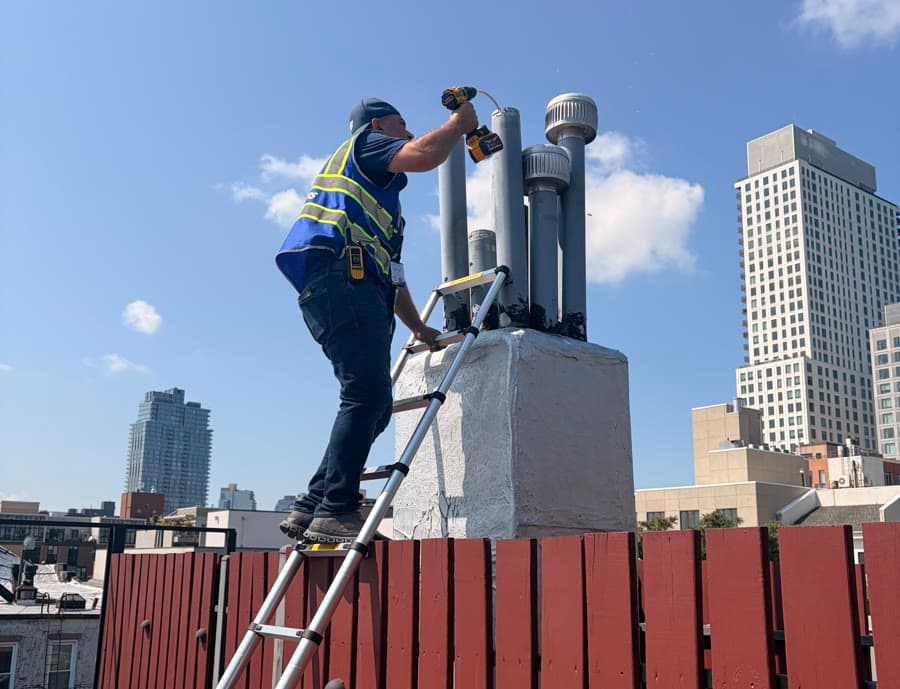
A bank of per-unit dryer risers where they terminate on a Brooklyn roof — one pipe per apartment, brushed from the roof down toward each unit's machine. No sound on this clip.
Access
Getting into the units is the actual job.
The cleaning is the easy part. Coordinating dozens of occupied homes is what makes a building job take a week instead of a day, and it’s the part that lands on your super if nobody plans it. So we plan it first.
A schedule your super can post
We give you a block of units per day with a time window for each, in a form you can put on the door and slip under it. Your building's own notice rules come first — tell us what they are and we'll build the schedule around them.
We come back for the ones who weren't home
Some units won't answer. That's normal, and it isn't a reason to bill you for a locked door. Missed units go on a return pass, and you only pay for units we actually cleaned.
One crew, in and out of each unit
We work the stack rather than wandering the building — a line of units, top to bottom, so residents on a given floor deal with us once. The whole visit is a lint trap, a hose, and a duct run per unit.
You get it in writing, unit by unit
Which units were cleaned, which weren't home, and anything we found that the board should know about, with photos. That's the document your board files, your agent keeps, and your insurer asks for.
Want the long version first? We wrote up how co-op and condo jobs actually go — board letters, certificates of insurance, freight elevators, shared shafts, and what tends to go wrong.
Paperwork
Everything your board will ask for.
Certificate of insurance
Same day, or within 24 hours
Tell us who the certificate should go to and we’ll send it to your board or managing agent. We carry $2M in liability coverage. If your building needs additional-insured wording, send it with your request and we’ll tell you what our carrier needs and how long it will take.
A record your board can file
After the job you get a written record, unit by unit, showing what was cleaned, who wasn’t home, and anything we found.
| Unit | Status | Notes |
|---|---|---|
| 2A | Cleaned | No issues found |
| 2B | Not home | On the return pass |
| 3A | Cleaned | Crushed hose, photo attached |
Pricing
We quote this one. Here’s why.
We publish flat prices for our residential services — you can see them on our pricing page. Buildings are the exception, and we’d rather explain that than pretend otherwise.
An eight-unit walk-up with short wall runs and a sixty-unit building sharing two roof risers are the same service and completely different jobs. Four things move the number, and none of them can be answered from a web form:
- How many units, and how many actually have a dryer
- Whether the dryers are in the units, in a shared laundry room, or both
- How the risers run, and where they terminate — roof or wall
- How access will work, and what your building's notice rules are
So we walk the building, and then you get a firm number in writing — before any work starts, with no deposit and no obligation to say yes.
We’ll quote it the way you need to approve it. The whole building in one pass is usually cheaper per unit and easier on your super — but if it has to be the risers this year and the unit-side runs at the next budget, or a line of units at a time, say so. A phased plan that actually passes beats a perfect one that stalls in committee.
Brooklyn only — but not condos only
Two things worth being straight about. Building work is Brooklyn-only for now — we’d rather do one borough properly, on the unit-by-unit schedule these jobs need, than spread a small crew across five. Our residential dryer vent cleaning does cover the rest of NYC and the Five Towns, and if you’re just over the borough line, ask anyway — we’ll tell you straight rather than string you along.
But inside Brooklyn it doesn’t have to be a condo. Co-ops, rental buildings, HOAs and townhouse communities are the same work, and if you manage several buildings we’d rather talk about all of them at once. If your dryers are in a shared laundry room instead of the units, we clean those too, and you can start right here either way.
Fully insured & accountable
Fully insured and accountable.
Every Vent Pro NYC visit is backed by what actually matters — $2M liability insurance, a 14-day satisfaction guarantee, and 10+ years of dryer-vent and air-duct experience across NYC and Long Island. All of it done by the family that owns the company.

5-star premium service

$2M liability insured
CERT — Community Emergency Response Team

14-day satisfaction guarantee
Trusted in 2,680+ NYC homes.
I knew something was up when my clothing was taking forever to dry but when the check vent light went on I knew it was a fire hazard. Eyal responded to my text in minutes, booked an appointment on the spot for the next day and showed up on time. He didn't mind that I was standing over to watch the whole process and boy was it satisfying. I couldn't believe the lint that was living in the dryer, behind the wall and at the exit vent on the side of my house. This is not the DIY job you think it is. well worth the visit!
Request a quote
Tell us about your building.
Four things and you’re done — you don’t need the unit count or the riser layout to start. We’ll call you to set up a walkthrough, or just call us at (718) 541-5567 if that’s easier.
Let's walk your building.
Tell us where the building is and we'll come look — unit count, whether the dryers are in the units or a shared room, how the risers run, and how access will actually work. You get a firm price in writing after that, not before. No deposit and no obligation. Brooklyn only.